

Updated: July 2026 · Reading Time: ~4 Minutes · Category: Press Technologies
Punching a sheet metal part, bending a bracket, or press-fitting a suspension bushing—many of these operations in automotive manufacturing rely on the same machine: the C-frame press. With its compact design and three-sided open die area, it provides one of the most practical solutions for both manual workstations and automated robotic cells.
Quick route: If you’re looking for a C-frame press with the right tonnage, stroke, and throat depth for your application, explore the Dynaress C-Frame Press Sales Page or request a quotation directly.
What Is a C-Frame Press?
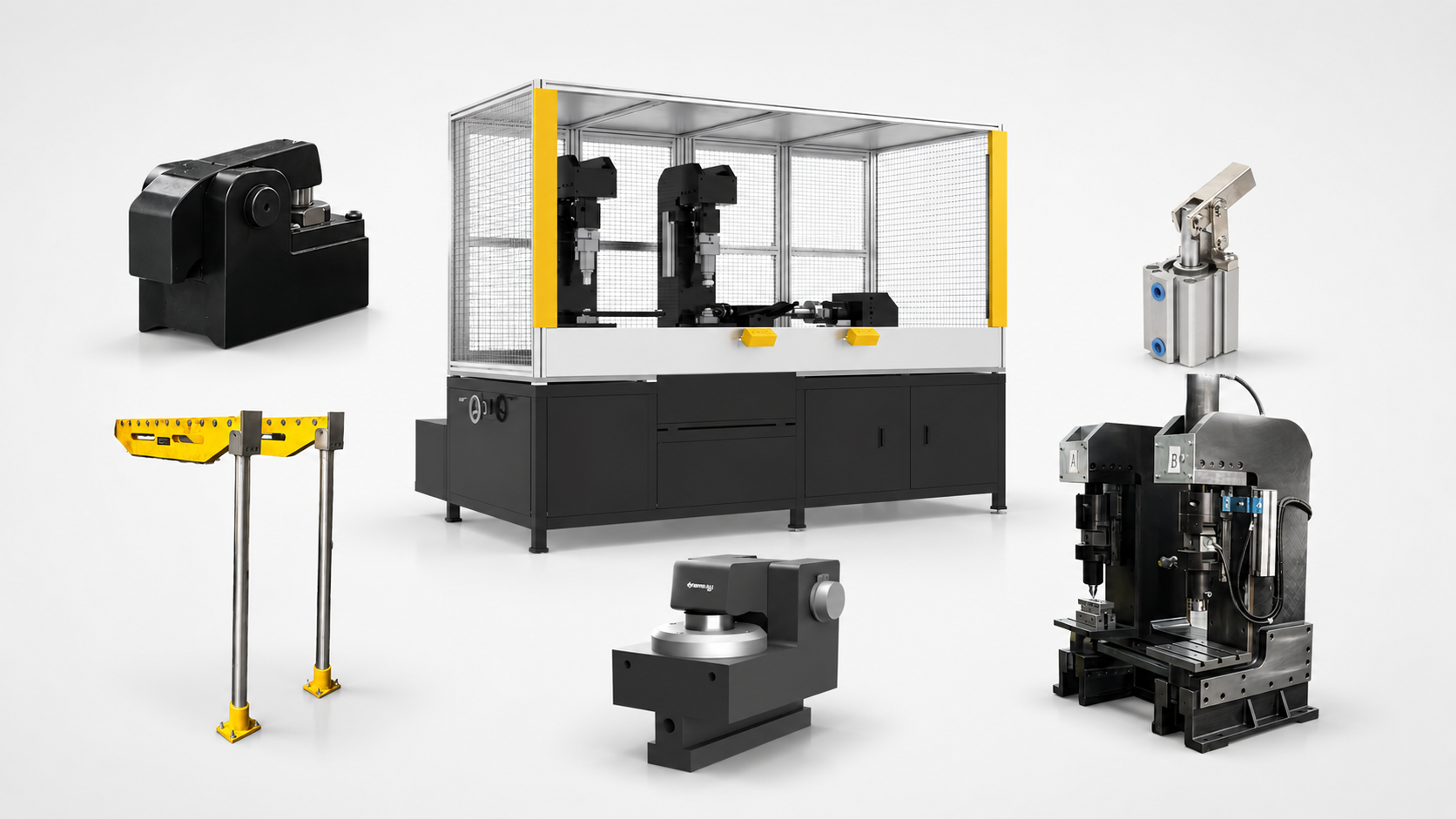
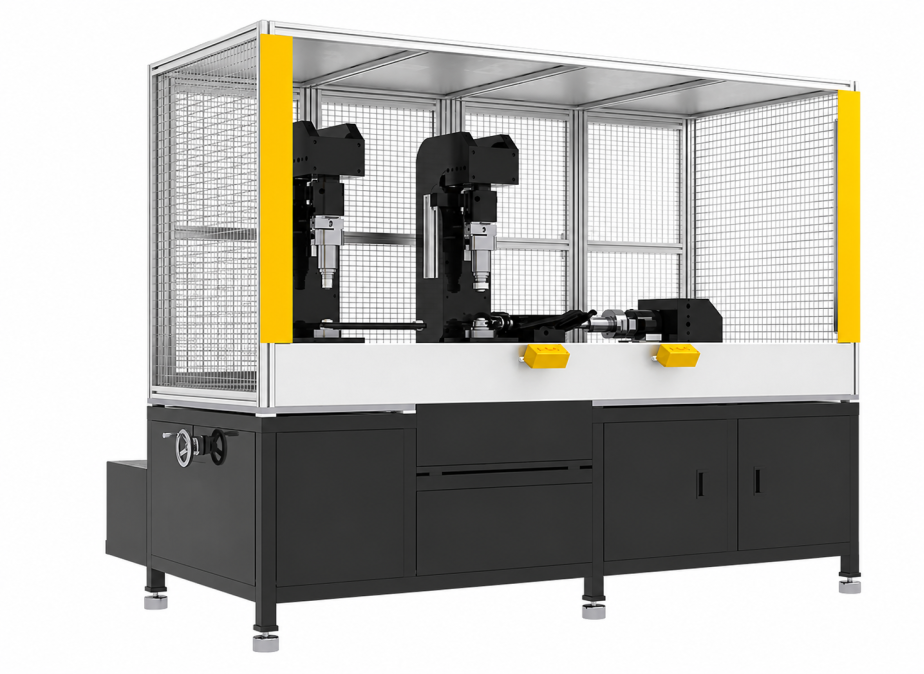
A C-frame press (also known as a gap frame press) is a type of press with a frame that resembles the letter “C” when viewed from the side. Its front and both sides are open, providing three-sided access to the die area. This open-frame design allows parts to enter from one side and exit from the other, enabling faster die changes and giving robotic arms greater freedom of movement.
The trade-off is physical: when force is applied, the open side of the C-frame tends to spread slightly like a spring. This behavior, known as angular deflection, can be minimized through thick welded steel construction, extensive ribbing, FEA-based design, and multi-point slide guidance systems. Depending on the drive system, C-frame presses are available in mechanical, hydraulic, pneumatic, and servo-electric configurations.
Which Automotive Operations Use C-Frame Presses?
- Blanking, punching, and trimming: Used for manufacturing brackets, connecting plates, clamps, and mounting plates.
- Bending, calibration, and straightening: Used for flange bending, sizing (coining), and restoring the geometric accuracy of parts distorted after welding.
- Bushing and bearing press-fitting: Used for press-fitting rubber-to-metal bushings into control arms, as well as installing ball joints, seals, and pins.
- Riveting, clinching, and staking: Used for cold joining in mixed-material assemblies such as aluminum and steel.
- Marking: Dot peen marking, stamping, and serial number engraving—forming the foundation of part traceability.
In press-fit assembly, the force–displacement curve effectively serves as the part’s quality certificate. It verifies whether the interference fit is correct, whether the bore is within tolerance, and whether the component has been seated to the required depth. Excessive force can damage the bearing race and lead to premature field failures, while insufficient force may result in a loose fit that becomes unstable under vibration.
Dynaress C-Frame Presses
At Dynaress, we size C-frame presses for automotive OEMs and suppliers by calculating the actual load requirements of each application. We manage the entire process in-house, from design and manufacturing to commissioning and automation integration.
- Önceki biçimi koruyarak:
Application-specific sizing: Tonnage, stroke, throat depth, and bed dimensions are calculated based on your part requirements—tailored to your application rather than limited to standard catalog specifications. - Drive options: Hydraulic, pneumatic, and servo-electric systems with programmable force, speed, and position profiles for critical assembly applications.
- Process monitoring: Force–displacement (XY) curve recording, OK/NOK decision-making based on envelope criteria, MES/SPC integration, and part-level traceability with an infrastructure designed to support IATF 16949 compliance.
- Safety architecture: Light curtains, two-hand controls, safety PLCs, and stopping-time verification in accordance with EN ISO 16092 and EN ISO 13849-1.
- Automation: Robot loading and unloading, feeders, conveyors, and turnkey automated cell integration.
- After-sales support: Spare parts supply, preventive maintenance services, and process improvement consulting.
Let’s Size Your Project Together. Share your part, material, and cycle time requirements, and let’s determine the right tonnage and configuration together. Click here for product details and a quotation.
C-Frame or H-Frame Press?
| Criteria | C-Frame (Gap Frame) | H-Frame (Straight-Side) |
| Frame | Open, three-sided access | Closed, four-post frame |
| Rigidity | Subject to angular deflection | Very high rigidity, minimal deflection |
| Typical tonnage | Typically up to 300 tons | 1,000 tons and above available |
| Footprint / Cost | Compact, cost-effective | Larger footprint, higher investment cost |
| Ideal Applications | Blanking, punching, bending, bushing press-fitting, riveting, and marking | Deep drawing, large panels, and transfer lines |
Quick rule of thumb: If the load is applied close to the center of the ram and the required tonnage is moderate, a C-frame press typically offers the best balance of performance and cost. If the load is significantly off-center or the required tonnage is high, an H-frame press should be considered.
How to Select the Correct Tonnage?
- Blanking force: Calculate the required force using the cutting perimeter × material thickness × shear strength (approximately 70–80% of the material’s tensile strength). Add an additional 5–20% to account for stripping force.
- For press-fit assemblies, the required force is calculated based on the coefficient of friction × contact pressure × contact area. For rubber bushings, the calculated value should always be validated through sample press-fitting trials.
- Add a 20–30% safety margin to the calculated force.
- Do not overlook off-center loading: As the load moves away from the center of the ram, the frame deflects and the ram tilts, leading to one-sided burr formation, dimensional inaccuracies, and accelerated die wear.
- Match the throat depth, stroke, and shut height to the geometry of your part and die.
- Define your process monitoring requirements in the specification from the outset—adding them later is both more expensive and less effective.Proses izleme ihtiyacını baştan şartnameye yazın — sonradan eklemek hem pahalı hem eksik olur.
Three Critical Aspects of Safety and Maintenance
- Regulatory compliance: Presses fall under Annex IV of the Machinery Safety Directive, with the EN ISO 16092 series serving as the current harmonized standard for mechanical, hydraulic, and pneumatic presses. In Türkiye, periodic inspection is mandatory under Occupational Health and Safety Law No. 6331.
- Light curtain safety distance: Calculated in accordance with EN ISO 13855. The machine’s stopping time must be measured, not estimated. As brake linings wear, the stopping time increases—therefore, it should be revalidated after maintenance.
- Maintenance: Approximately 75% of hydraulic system failures are linked to fluid contamination. Filtration, oil analysis, clutch and brake lining inspection, and slide clearance monitoring are among the maintenance activities that deliver the highest return.
Frequently Asked Questions
How much tonnage can a C-frame press be manufactured for?
Depending on the application, C-frame presses are generally used for capacities of up to 300 tons, while gap-frame mechanical press series are typically available in the 35–250 ton range. For higher tonnage applications, an H-frame press is generally preferred.
Which press is suitable for bushing press-fitting?
Hydraulic or servo-electric C-frame presses are preferred because they allow the force to be applied in a controlled manner and enable traceability for every part. Servo presses provide 100% quality documentation through force-displacement curve monitoring.
My tonnage is sufficient, but the part quality is deteriorating. What could be the cause?
The most common cause is off-center (eccentric) loading; the second most common cause is excessive slide clearance. Both cause the ram to descend at an angle and lead to uneven wear.
Conclusion
A C-frame press is one of the most flexible and often most economical solutions for a wide range of automotive manufacturing operations, from cutting to bushing press-fitting. However, it must be selected correctly: tonnage, throat depth, off-center loading, and process monitoring requirements should be evaluated together.
Let’s choose the right press together. Click here for Dynaress C-frame press models, technical specifications, and a quotation.
References
1. AIDA Engineering — Gap Frame Mechanical Press (NC1/NC2) teknik dokümantasyonu ve servo pres teknolojisi. aida-global.com
2. ADH Machine Tool — “Types of Press Machines” ve “The Ultimate Guide to Hydraulic Presses” (C gövde açısal sehim ve merkez dışı yükleme). adhmt.com
3. H&T Produktionstechnologie — “What Is the Difference Between a C-Frame and H-Frame Mechanical Press?” ht-pt.com
4. Kistler — Elektromekanik birleştirme sistemleri ve maXYmos NC kuvvet-yol izleme. kistler.com
5. Absolute Gauge Technologies / Coretec — “Integrated Assembly Servo Press” (süspansiyon salıncak kolu burç presleme). absolutegauge.com
6. ISO 16092-1/-2/-3/-4 — Machine tools safety: Presses; ISO 13855; ISO 13849-1.
7. Pilz GmbH — “Presses: Maximum Safety in Metalworking” (EN ISO 16092 serisi, Makine Direktifi Ek IV). pilz.com
8. Oxmaint — “Press & Stamping Equipment Maintenance” (hidrolik arızalarda akışkan kirliliği payı). oxmaint.com