


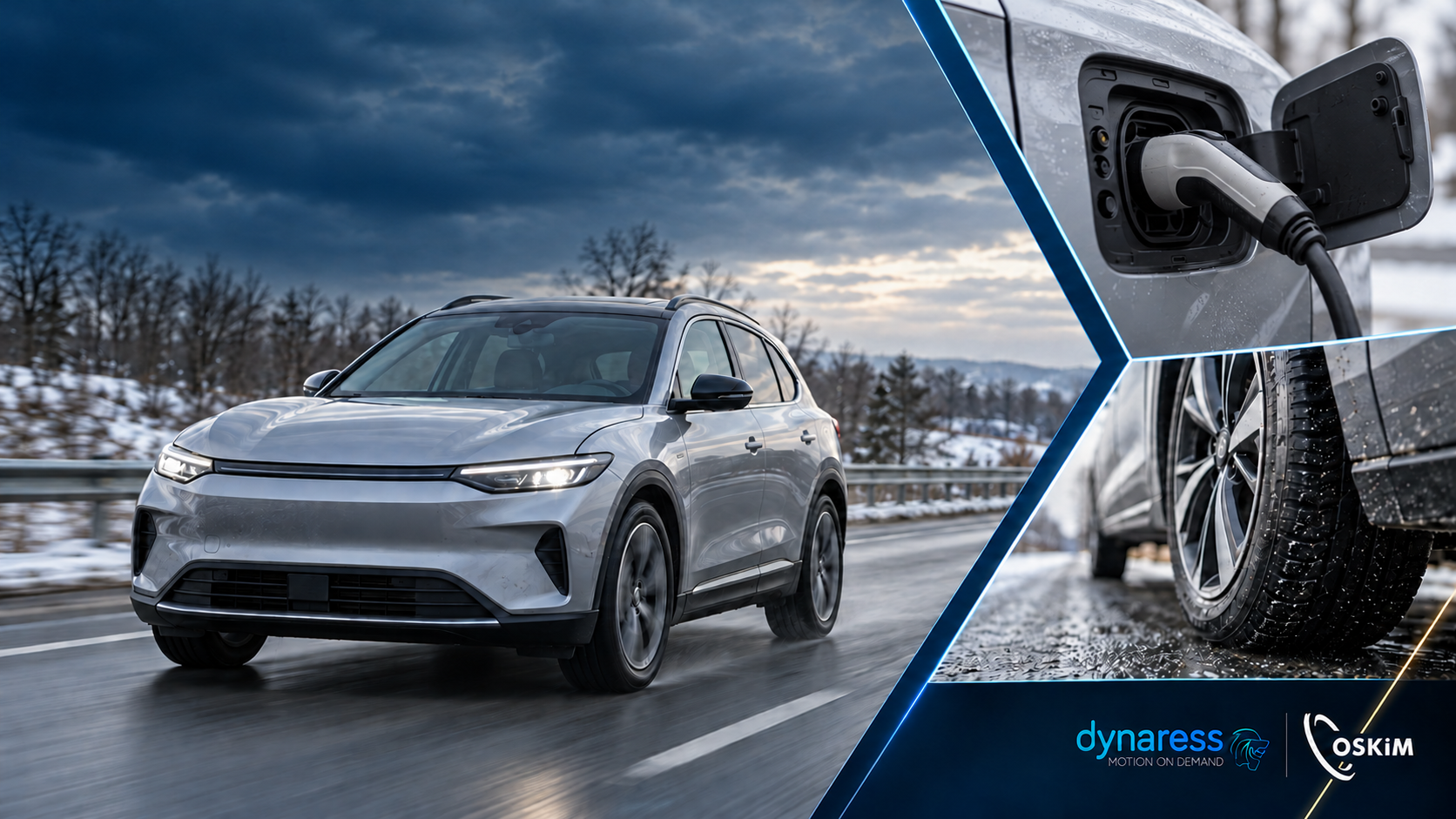
An electric car may not cover the same distance every day, even when it starts with the same state of charge. A city drive on a mild day and a high-speed motorway journey on a cold day demand different amounts of energy. Speed, outdoor temperature, road gradient and the use of the heating system all affect consumption.
The battery supplies energy not only to move the car, but also to heat or cool the cabin and keep the battery within its ideal operating temperature range. As these demands increase, the distance covered on a single charge decreases.
Fast battery drain does not mean the battery has degraded
The energy used during a journey and the loss of battery capacity over time are two different matters. The first relates to energy consumption on the road. The second refers to the gradual reduction in the amount of energy the battery can store.
Cold weather can reduce the amount of energy available from the battery. Much of this reduction returns when the battery reaches a normal operating temperature. For this reason, lower winter range alone does not indicate permanent battery damage.
High speed: One of the main reasons for higher motorway consumption
As speed increases, the vehicle needs more energy to overcome aerodynamic drag. This effect becomes particularly clear at motorway speeds. Even when the car travels at a constant speed, the motor must continuously work against air resistance.
As a result, an electric car that shows low consumption in city traffic may use considerably more energy on the motorway. A study based on dynamometer testing of eight different electric vehicles also demonstrated the effect of speed and acceleration on the power drawn from the battery.
Keeping speed at a reasonable level is one of the most direct ways for drivers to preserve range during motorway journeys.
Cold weather: Several factors increase consumption at the same time
Winter range loss cannot be explained by cabin heating alone. Low temperatures increase the battery’s internal resistance and reduce the amount of usable energy. The vehicle may also use additional energy to heat the battery. Cabin heating adds another demand to the system, increasing total consumption.
Cold temperatures also affect the amount of energy recovered during braking. When the battery is cold, the vehicle’s control system may limit regenerative braking to protect the battery. As a result, less energy returns to the battery during deceleration.
The impact depends on battery temperature, the vehicle’s thermal management system and the conditions of the journey. There is no single winter range-loss percentage that applies to every electric car.
Cabin heating and air conditioning: Energy is used even when the car is stationary
Cabin heating is a significant energy demand in electric vehicles. Internal-combustion vehicles can use waste heat from the engine, while electric vehicles require separate heating solutions. Resistive heaters and heat pumps are among the technologies used for this purpose.
A study by researchers at the National Renewable Energy Laboratory showed that heating the areas occupied by passengers, instead of heating the entire cabin equally, reduces energy demand. Seat heating can maintain passenger comfort while allowing the cabin temperature to remain lower under suitable conditions.
A heat pump can also use less electricity than a resistive heater in certain conditions. Its efficiency decreases at very low outdoor temperatures, however, and additional heating support may be required.
In hot weather, the air-conditioning system and battery cooling also increase consumption. The effect of heating or cooling on range depends on the outdoor temperature and the duration of use.
Short trips: The initial heating cost is spread over fewer kilometres
Heating a cold cabin at the beginning of a journey can significantly increase energy consumption per kilometre on short trips. When the vehicle is parked after only a few kilometres and cools down again, the same energy demand appears at the start of the next journey.
A 2021 study that examined the data of a compact electric car monitored for approximately four years found that trips shorter than 16 kilometres used, on average, around 10% more energy per kilometre than longer trips. This result applies to the vehicle and conditions examined in that study.
If the vehicle supports the feature, preheating the cabin while the car is connected to a charger reduces the heating demand supplied by the battery during the journey. Preheating still consumes electricity; drawing that electricity from the grid does not mean the process uses no energy.
Frequent acceleration and hard braking: Regenerative braking has limits
Repeated acceleration and deceleration increase energy consumption. Studies based on real-world driving data show that driving style has a direct effect on electric vehicle consumption.
Regenerative braking converts part of the vehicle’s kinetic energy into electricity during deceleration and sends it back to the battery. The system cannot recover all of the energy used to accelerate. Losses occur within the electric drivetrain, while braking handled by friction brakes sends no energy back to the battery.
Following traffic more smoothly, reducing unnecessary acceleration and keeping a suitable following distance create a more balanced driving pattern. The presence of regenerative braking does not make unnecessary acceleration and braking energy-neutral.
Long climbs and additional load: The energy demand of the route changes
When a vehicle climbs a hill, it works against gravity. For this reason, covering the same distance on a rising road and on level ground requires different amounts of energy.
A study using data collected from 68 electric vehicles in Japan examined the effect of road gradient on energy consumption. Regenerative braking helps recover energy on downhill sections, but changes in elevation still need to be included when calculating the energy demand of a route.
Additional weight also increases energy demand, especially during acceleration and uphill driving. The effect depends on the route and driving style.
Headwinds and roof racks: Consumption can rise even at the same indicated speed
A headwind increases the vehicle’s speed relative to the air. The driver may see the same speed on the instrument cluster, while the vehicle faces greater aerodynamic drag.
Roof racks and loads mounted on the roof also change the airflow around the vehicle. The effect becomes more significant at higher speeds. Studies examining electric vehicle use on motorways have identified headwinds, roof racks and additional load as conditions that affect range.
Removing roof equipment that is not in use is a simple measure worth considering before a long journey.
Low tyre pressure: An energy loss repeated over every kilometre
Energy is lost as the tyres roll along the road. Low tyre pressure increases this loss, forcing the motor to use more energy to keep the vehicle moving. Real-world testing has shown that lower tyre pressure can increase power losses in the tyres.
For this reason, tyre pressure should be checked according to the cold-tyre values and load conditions specified in the vehicle owner’s manual. Raising tyre pressure above the manufacturer’s recommended level in an attempt to reduce consumption is not an appropriate maintenance practice.
What should drivers consider in daily use?
State of charge alone does not provide enough information when assessing range. When comparing consumption on the same route, outdoor temperature, speed, vehicle load and air-conditioning use should also be taken into account.
Keeping motorway speed at a reasonable level, avoiding unnecessary acceleration, checking tyre pressure and removing unused roof equipment all help reduce consumption. In winter, drivers can use preheating while the vehicle is connected to a charger, if the vehicle supports the feature. The cabin temperature should be adjusted with both comfort and clear windows in mind, while driving safety remains the priority.
Sources
- Galvin, R. (2017). Energy consumption effects of speed and acceleration in electric vehicles: Laboratory case studies and implications for drivers and policymakers.
- Yuksel, T. and Michalek, J. J. (2015). Effects of Regional Temperature on Electric Vehicle Efficiency, Range, and Emissions in the United States.
- Liquid electrolyte development for low-temperature lithium-ion batteries (2022). Energy & Environmental Science.
- Effect of Low Temperature on Electric Vehicle Range (2021). World Electric Vehicle Journal.
- Jeffers, M., Chaney, L. and Rugh, J. (2016). Climate Control Load Reduction Strategies for Electric Drive Vehicles in Cold Weather.
- U.S. Department of Energy (2024). Impact of Cold Ambient Temperatures and Extreme Conditions on Electric Vehicles.
- Al-wreikat, Y., Serrano, C. and Sodré, J. R. (2021). Driving behaviour and trip condition effects on the energy consumption of an electric vehicle under real-world driving.
- Sørensen, Å. L., Ludvigsen, B. and Andresen, I. (2023). Grid-connected cabin preheating of Electric Vehicles in cold climates.
- Liu, K., Yamamoto, T. and Morikawa, T. (2017). Impact of road gradient on energy consumption of electric vehicles.
- Impact of lightweighting and driving conditions on electric vehicle energy consumption: In-depth analysis using real-world testing and simulation (2025).
- Wager, G., Whale, J. and Bräunl, T. (2016). Driving electric vehicles at highway speeds.
- Sina, N., Nasiri, S. and Karkhaneh, V. (2015). Effects of resistive loads and tire inflation pressure on tire power losses and CO₂ emissions in real-world conditions.
- U.S. Department of Energy (2024). A Typical EV is 87%–91% Efficient Compared to 30% for a Conventional Gasoline Vehicle.